MLB Online Betting in the UK: A Data-Led Guide for British Punters
 Available in US
Table of Contents
- Why Major League Baseball Is the British Punter’s Quiet Edge
- The British MLB Punter’s Quick Brief
- The Legal Status of MLB Betting in Britain
- Inside the UK Betting Market Behind Your MLB Slip
- How an MLB Bet Actually Works at a UK Sportsbook
- The Core MLB Markets You Will See on a UK Sportsbook
- UK-Licensed Bookmakers Carrying MLB
- What the 2025 MLB Season Tells a UK Bettor
- Building a Routine Around the Five-Hour Gap
- The UK Player-Protection Layer You Cannot Switch Off
- Stake, Payout and the Tax Question Britons Keep Asking
- Where to Go Next on RunLine Lab
- Common Questions on MLB Betting in the UK
Why Major League Baseball Is the British Punter’s Quiet Edge
Betting on Major League Baseball from a flat in Manchester or a pub in Glasgow is legal, provided you bet with a UK Gambling Commission-licensed operator. That single sentence sorts out the question most punters arrive with — and immediately opens a more interesting one, because MLB sits in a strange spot for the British market. A 162-game regular season produces 2,430 fixtures every year, more matches than the Premier League, Championship and EFL combined, and almost every one of them starts after the average UK punter has gone to bed.
I have spent eleven years modelling pitcher matchups, run-line value and live in-play markets across the major UK books, and I will say this plainly: MLB is the most under-priced major sport on a British coupon. The football market is brutally efficient because the entire country has an opinion on it. Baseball is not. That gap is where the value lives, and where the trouble lives if you wander in without a plan.
01 — What this guide covers
The data-led overview: UKGC framing, how decimal and fractional odds map onto American lines used by US sources, an honest tour of the core markets — moneyline, run line, totals, props, futures — plus the timing, tax and responsible-gambling layers that British punters specifically need. Cluster guides go deeper on each market.
The UK regulated gambling market is the largest in the world, with gross gambling yield at £15.6 billion at the Commission’s last full statement. MLB does not own a meaningful slice — football and horse racing dominate the British coupon — but the sport’s three consecutive seasons of attendance growth, capped by 71.4 million fans through the gates in 2025, have pushed UK bookmakers to widen their baseball offering. The London Series and the Tokyo Series are doing the rest.
£15.6bn
UK regulated gross gambling yield
2,430
MLB regular-season fixtures every year
71.4m
MLB 2025 attendance, third straight year up
2h 38m
Average game length in 2025 under the pitch clock
What follows is a working framework: where MLB sits inside UK gambling regulation, what your money is actually doing on a run line, why a 5/4 fractional price is sometimes worse than a 2.20 decimal, how the time difference reshapes a sensible routine, and where to walk away. By the end you should be able to evaluate any MLB market a UK book throws at you without needing the marketing copy at the top of the page.
The British MLB Punter’s Quick Brief
- MLB betting in the UK is legal at any UKGC-licensed operator — verify the licence number in the site footer before depositing a penny.
- UK gambling winnings are not subject to income tax or capital gains tax; the operator pays General Betting Duty and Remote Gaming Duty, both rising sharply from 2026.
- Decimal odds (1.91), fractional (10/11) and American (-110) all describe the same price; learn to convert between them before reading any US-published preview.
- Run line, totals and F5 derivatives are where serious value sits — moneyline is where most casual money goes.
- The five-hour Atlantic gap means the morning slate is the British bettor’s friend; overnight in-play is where bankrolls disappear.
The Legal Status of MLB Betting in Britain

A colleague once spent twenty minutes on the phone to a Reddit user from Birmingham convinced he was going to be arrested for backing the Dodgers from his laptop. He had been reading American forums, where state-by-state legality is a real and ongoing battle, and assumed Britain must be somewhere in the middle of that mess. Britain is not.
MLB betting in the UK is regulated under the same statutory framework as every other sport: the Gambling Act 2005, supervised by the Gambling Commission, which issues operating licences to anyone offering remote betting to British customers. Baseball is not a special category. If a bookmaker holds a Remote Gambling Licence for sports betting in Britain, they can offer markets on Major League Baseball, the Korea Baseball Organization or Sunday afternoon British Baseball Federation matches.
The regulated remote sector — casino, betting and bingo combined — generated £7.8 billion in gross gambling yield in the most recent annual reporting period, up 13.1 per cent year on year. UKGC chief executive Andrew Rhodes framed the scale plainly: “Great Britain is home to the largest regulated online gambling market in the world, with a gross value now north of £15 billion, with some 22.5 million adults engaging on a regular basis.” That scale is why British punters get protections their American counterparts can only dream about.
02 — Three legal facts that matter for MLB
You must be 18 or over. The operator must hold a UKGC remote betting licence — the licence number sits in the footer of every legitimate site. And your winnings are not subject to UK income tax or capital gains tax, regardless of size, because betting duty in Britain is paid by the operator under the General Betting Duty and Remote Gaming Duty regimes rather than the customer.
The Commission has tightened its consumer-protection rules considerably in the past two years. From 28 February 2025, remote operators must perform financial vulnerability checks on customers who net-deposit more than £150 over a rolling thirty-day window. That threshold replaced an earlier £500 ceiling and is materially lower than what most casual American baseball bettors would face. The check itself is light-touch — typically a credit-bureau lookup — but the principle is clear: the regulator wants operators noticing patterns before they become problems.
Remote operating licence — the specific category of UKGC permission that allows a bookmaker to take bets online or via mobile from British customers. A retail-only shop licence does not cover MLB betting on your phone; the operator needs the remote licence specifically.
One legal nuance British punters routinely miss: offshore sites — sportsbooks based in Curaçao, Costa Rica or other lightly regulated jurisdictions — will happily take bets from UK IP addresses. They are not legal in the regulatory sense; they hold no UKGC licence, are not bound by affordability rules, are not enrolled in GAMSTOP, and disputes with them have no British ombudsman. The Betting and Gaming Council estimates the black-market handle has grown to £16.6 billion, roughly triple where it sat in 2019, and BGC chief executive Grainne Hurst has been blunt about the trend: “What we are seeing is a harmful black market scaling up at pace. Illegal operators are becoming more sophisticated, more visible and more aggressive in how they reach UK customers.” Stick to the licensed channel — there is a deeper breakdown of how UKGC rules shape MLB wagering in the cluster guide.
Responsible gambling reminder — UKGC licensing exists because betting can become harmful. The protections in this section are floors, not ceilings. If at any point a stake size, a chase or a market becomes a problem rather than a pastime, GAMSTOP self-exclusion and BeGambleAware are available immediately, free of charge, and outside any operator’s control.
Inside the UK Betting Market Behind Your MLB Slip
Most punters never look at the industry numbers behind the app on their phone, and I do not blame them. But the macro picture explains things you cannot otherwise account for: why baseball lines suddenly tightened in 2024, why bonus offers shrank in 2025, why your favourite bookmaker started asking for a payslip after a £200 deposit. The money behind the curtain dictates what you see in front of it.
£16.8bn
Total UK gross gambling yield, April 2024 to March 2025
£1.45bn
Total online GGY, January to March 2025, up 7 per cent year on year
13.5m
Average monthly active accounts at UK online operators
£596m
Online real-event betting GGY, Q4 of fiscal 2024–25, up 5 per cent
That fourth tile is the one a baseball bettor should care about. Real-event GGY is the slice of operator revenue from people backing actual sporting events rather than virtual football or casino slots. UK operators do not break out baseball specifically, yet the year-on-year line additions — F5, alternate run lines, first-inning markets — tell the same story as the macro: the audience is widening. The dominant non-lottery gambling group is now 25 to 34-year-olds, with 35 per cent participation, and roughly 290 million online bets on real events are placed in the UK every month.
What is growing
- Online real-event GGY (+5 per cent year on year)
- Total online GGY (+7 per cent year on year)
- 25-34 demographic gambling participation
- MLB market depth at UK books
- Statutory levy collection (~£120m in 2025)
What is shrinking or under pressure
- High-street betting shops (5,825 left, down 30 per cent since 2019)
- Generous welcome bonuses (squeezed by 2026 duty rises)
- Frictionless high-stake deposits (£150 trigger)
- Operator margins on online slots (£5/£2 stake caps)
- Regulated channel share (97 per cent in 2019, 92 per cent in 2025)
Two structural shifts will reshape MLB betting in 2026 and 2027. From April 2026 Remote Gaming Duty jumps from 21 per cent to 40 per cent on online casino, and General Betting Duty on remote sports betting climbs from 15 per cent to 25 per cent from April 2027 — the most aggressive tax rise the UK regulated market has ever absorbed in a single Budget. It will not show up immediately as worse MLB prices, but it will show up. Operators have already started trimming free-bet generosity and tightening lines on niche markets, and MLB sits in the niche bucket.
The statutory gambling levy collected close to £120 million in its first full year — roughly twice the peak voluntary contributions of the previous decade. BGC chief Grainne Hurst called the duty package “a devastating hammer blow to tens of thousands of people working in the industry across the UK, and millions of customers who enjoy a bet.” Whether or not you share that framing, the operational reality is straightforward: more expensive bookmakers offer tighter prices.
The black-market growth is the part that ought to worry anyone betting on baseball in the UK, even those who do not personally stray off-licence. Black-market UK betting reached £16.6 billion in 2025, almost triple the 2019 figure, and the regulated channel share has slid from 97 to 92 per cent in six years. Each percentage point lost to offshore operators is GGY the legitimate market has to make up elsewhere — through tighter holds, smaller free bets, more aggressive promotions on high-margin verticals.
How an MLB Bet Actually Works at a UK Sportsbook

The first time I tried to read an MLB line, I was a teenager flipping between an American forum and a William Hill coupon, genuinely confused why a “minus one fifty” team was 1/2 on one screen and 1.67 on another. Twenty minutes with a calculator later it clicked. If you have grown up on fractional or decimal prices, the American number is the strange one, and almost every US-published preview uses it.
An MLB bet at a UK book follows the same plumbing as any other sports bet: select a market, stake a sum, confirm at the displayed price. Behind that flow sits an enormous amount of pricing work — opening lines pulled from offshore market-makers, sharper-money adjustments, in-house liability balancing across hundreds of markets per game. The price you see is the operator’s commercial guess at where roughly equal money lands on each side after the inevitable hold.
That hold — overround, vig — is how the bookmaker pays for the operation regardless of who wins. On a coin-flip MLB game the fair price would be 2.00 each side. UK books typically post around 1.91 / 1.91, which bakes in roughly a 4.7 per cent hold over a two-way market. UK markets are generally tighter than the headline US hold on MLB-style two-way games, which is one reason regulated British books remain competitive for the well-informed punter.
| Format | Underdog price | Favourite price |
|---|---|---|
| Decimal (default UK online) | 2.50 | 1.61 |
| Fractional (UK heritage) | 6/4 | 8/13 |
| American (US sources) | +150 | -164 |
Three formats describe the same probability. Decimal multiplies directly with your stake to give total return including stake back. Fractional, still used by Racing Post, shows profit only. American odds use plus and minus relative to a $100 baseline: positive American to decimal, divide by 100 and add 1, so +150 becomes 2.50; negative American to decimal, divide 100 by the absolute number and add 1, so -164 becomes about 1.61.
A simple MLB worked example: £20 on the Yankees moneyline at 1.91
Stake: £20.00
Decimal odds: 1.91
Total return if Yankees win: 20 × 1.91 = £38.20
Profit: £38.20 − £20.00 = £18.20
Loss if Yankees lose: £20.00, full stake
In fractional terms 1.91 reads as 10/11. In American terms it is roughly -110, the standard US two-way price. Implied probability is 1 ÷ 1.91, or 52.4 per cent. To break even long-term, your model needs Yankee wins more often than 52.4 per cent of the time.
That implied-probability calculation is the most important piece of arithmetic in baseball betting, because it turns the abstract price into a concrete forecast you can argue with. If your read says the Yankees win 56 per cent of the time and the book is offering 52.4 per cent, you have a four-point edge — and over a 162-game season with 2,430 fixtures, those edges compound into the bankroll faster than they do in football.
A few mechanical points British punters should internalise. Operators settle on the official MLB result, which is usually clear but occasionally — suspended games, rain delays into the next day — gets thorny. Pitcher-listed markets are voided if a scratched starter changes the price assumption; action-style markets settle regardless. Run lines and totals require official game length, normally nine innings or eight and a half if the home team is ahead. Each book has a specific rules page covering edge cases, and the rules are not identical.
The Core MLB Markets You Will See on a UK Sportsbook
Ask ten British punters what an MLB bet looks like and roughly eight will describe a moneyline. They are not wrong, but they are stopping at the front door. A competent UK book covers more than thirty bet types per game, and the difference between a value-finder and a profit-loser usually comes down to which markets they engage with. Each market has its own cluster guide on RunLine Lab; for the market-by-market anatomy, the full market-by-market breakdown sits in the dedicated guide.
Moneyline (match winner)
- Back a team to win the game outright
- No handicap, no draw in regulation-plus-extras
- Heavy juice on big favourites (-200 and shorter)
- Value sits on dogs in pitcher-mismatch spots
Run line (-1.5 / +1.5)
- Fixed handicap, roughly 50/50 by design
- Favourite must win by 2+ runs to cash
- Underdog +1.5 covers any one-run defeat
- Better price than moneyline on short fav
Totals (over/under)
- Combined runs across both teams
- Lines typically 6.5 to 11.5 in regulation
- Driven by starting pitchers, wind, park
- Settles on full game including extras
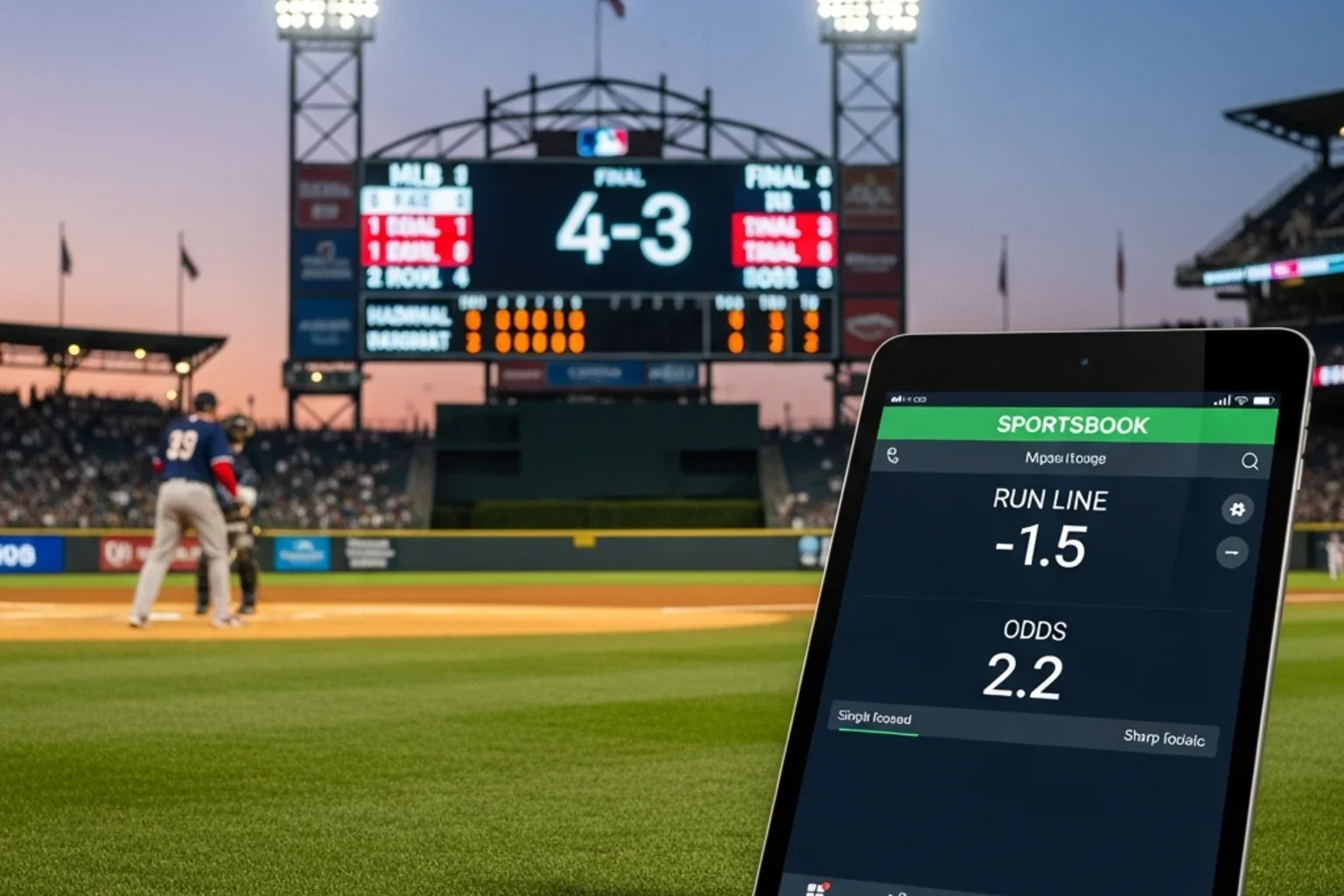
Those three account for the bulk of UK MLB handle. The moneyline is the cleanest expression of who you think wins. The run line, MLB’s equivalent of the football handicap, exists because baseball margins cluster heavily around one run — roughly 28 per cent of all MLB games end with a one-run margin, which is why the standard handicap sits at -1.5. Pay close to fair price on a heavy favourite at -1.5 and you are essentially paid to bet they win comfortably rather than just win.
Totals are where MLB rewards the engaged bettor most. The combined-runs line aggregates every variable that matters — starting pitcher quality, bullpen depth, ballpark dimensions, wind, weather, umpire strike-zone tendencies. UK bookmakers post these at 0.5 increments with two-way -110 style juice, moving on starter-confirmation news in the morning. Pitching is the single largest input on totals lines, and pitching analytics for sharper picks covers the underlying metrics — WHIP, FIP, K/9, times-through-the-order penalties — that drive every honest projection.
Derivatives and props: the deeper menu
Beyond the core three, a UK book worth its salt offers two further families. The first is derivatives — markets settled on a portion of the game. The most useful is First Five Innings, the F5 market, which settles purely on the runs scored through the top and bottom of the fifth. F5 strips the bullpen out of the equation, which matters because bullpen performance is the single most volatile element of an MLB game. If your read of the matchup is a starting-pitcher edge, F5 isolates it cleanly.
The second family is player props: home runs, hits, total bases, pitcher strikeouts, RBIs, stolen bases. UK availability lags US books — deeper US sportsbooks list dozens of prop markets per player; UK operators typically carry the headline three or four. The flagship UK props are pitcher strikeouts over/under and hitter to-hit-a-home-run yes/no, both modellable directly from rate stats. The market is thinner and holds are wider, but the inefficiency is sometimes worth the trouble.
03 — Market families on a typical UK MLB coupon
Core: moneyline, run line (-1.5/+1.5), totals (over/under). Derivatives: F5 runs total, F5 moneyline, first-inning runs yes/no. Props: pitcher strikeouts O/U, hitter home run yes/no, total bases. Futures: World Series, league pennant, division winner, MVP, Cy Young. Live: race-to-runs, next-inning runs.
First Five Innings settles on runs through the top and bottom of the fifth, so it is driven almost entirely by the two starting pitchers — the bullpen, the most volatile part of any game, is stripped out. If your edge is a starter mismatch, F5 isolates it. Enter each starter’s runs-allowed rate per nine innings (RA9 or FIP). The F5 moneyline is a three-way market: after five innings a tie is common, which is why „Tie” carries real probability. Fair odds carry no margin. Informational only.
Pitcher strikeouts model cleanly from rate stats: strikeouts per nine innings scaled to the innings you expect the starter to pitch, then nudged for how much the opposing lineup whiffs. High-strikeout lineups (raise the adjustment) inflate the total; contact lineups (lower it) suppress it. Probabilities use a Poisson count around the projection. This is one of the few UK props deep enough to model, though holds are wider than on the core three markets — shop the line. Informational only.
Futures sit at the long end of the menu. World Series odds open in November, refresh after each major free-agent signing, and squeeze considerably once spring training delivers injury news. The 2025 World Series ran the full seven games — Blue Jays against Dodgers, Game 3 stretching to 18 innings — and the futures market told that story all year. Event futures, including the London Series and Tokyo Series, sit in the same family and are covered in the World Series and Tokyo/London event betting guide.
UK-Licensed Bookmakers Carrying MLB
The British betting landscape has narrowed sharply over the past decade. There were 8,304 betting shops on Great Britain’s high streets in 2019; by March 2025 that figure had fallen to 5,825, a near-30-per-cent contraction. Online consolidation has kept pace. Six major operators now account for the bulk of UK gambling handle, and almost all of them carry some Major League Baseball coverage, though depth and quality vary enormously.
I am not going to rank bookmakers or recommend one — that work is poisoned by affiliate incentives industry-wide. Instead, here is the operator landscape as it sits, what they offer baseball punters, and what to look for when you size up the field for yourself.
bet365
Stoke-on-Trent based. The widest MLB market depth among UK operators: every game on the slate, all derivatives, deep prop menu, in-play covering inning-by-inning markets.
William Hill
Heritage brand under 888 Holdings ownership. Comprehensive moneyline, run-line and totals coverage with a fractional-odds display option that suits traditional UK punters.
Betfair
Operates both a fixed-odds sportsbook and the largest betting exchange in the UK. The exchange allows peer-to-peer MLB betting at lower implied holds than any fixed-odds book in the country.
888sport
One of the few UK operators that explicitly markets to a baseball audience. MLB sits as a tier-2 sport in their navigation rather than buried under American football.
Spreadex
Specialist spread-betting and fixed-odds operator. Offers spread markets on MLB run totals and innings totals alongside conventional fixed-odds, useful for the punter comfortable with variable stake exposure.
BoyleSports
Irish-founded, expanded into the UK retail and online market. MLB coverage on the standard markets with competitive opening lines on World Series futures.
Every operator in that grid holds a current UKGC remote operating licence, the licence number in the footer of each site. That single requirement does most of the heavy lifting on consumer protection: mandatory dispute resolution via an approved ADR provider, segregated client funds — deposits held separately from operator working capital, protected if the operator goes under — and inclusion in GAMSTOP. Add the financial vulnerability checks from 28 February 2025, the marketing opt-in rules from May 2025, and the responsible-gambling messaging requirements, and the regulatory floor is materially higher than any American or offshore equivalent.
04 — How to verify any UK bookmaker before depositing
Scroll to the footer of the website. Find the licence statement. It will look something like “Licensed and regulated by the Gambling Commission, licence number 12345-6789-AB”. Copy that number and search it on the Gambling Commission public register. If the licence is current, the operator is properly authorised. If the footer contains a Curaçao seal or no licence detail at all, walk away.
A few practical observations the marketing copy will not tell you. Live-market depth varies dramatically — bet365 and Betfair offer near-continuous pricing on every game; smaller operators may only carry moneyline and totals during play, or pull markets entirely during commercial breaks. F5 availability is patchy and tends to appear closer to first pitch. Fractional-odds display remains useful on derivatives where 6/4 reads more cleanly than 2.50; most platforms allow a one-click switch in settings.
Marketing opt-in — from 1 May 2025, UKGC rules require operators to obtain customer opt-in on a per-product and per-channel basis for direct marketing. You must affirmatively tick the boxes for sports betting communications, and the choice can be reversed at any time.
Two characteristics matter more than brand strength when you choose where to bet MLB seriously. The first is closing-line value: do this operator’s prices move in line with the sharper market between opening and first pitch? You can test this by tracking moneylines on a handful of games across three or four operators for a week. The second is settlement reliability on edge cases — pitcher changes, rain delays, suspended games. Read each operator’s MLB rules page once.
What the 2025 MLB Season Tells a UK Bettor

I bet at the start of last spring that the pitch clock would, by the end of the 2025 season, have reset the totals market across the league. That turned out roughly half right, half wrong, and the way it broke is one of the most useful pieces of MLB betting context a UK punter can sit with for ten minutes. The macro signals from 2025 directly informed the prices showing on your screen right now, and they will keep informing them through 2026.
2,430 games. 2h 38m average. Third consecutive season under 2:40. The last comparable run was 1983 to 1985.
The average MLB game took 2 hours and 38 minutes in 2025, marking the third straight season at or under 2:40 — a stretch the league had not seen since the mid-1980s. The pitch clock, larger bases and limit on pickoff attempts have collectively delivered what the rules committee said they would. Crucially for the bettor, faster games have not meant fewer runs. Run-scoring sat roughly flat, which means totals lines did not need to migrate downwards en masse. What did happen was a tightening of late-game variance — fewer marathon extra-innings games, fewer bullpen blow-ups in low-leverage spots — and that has subtly changed how the run line and totals trade from the seventh inning onwards on the in-play market.
71.4m
Total 2025 attendance, third straight rise
17.8bn
Social-media views on MLB channels, up 20 per cent
+27%
MLB.TV viewership growth year on year
$12.1bn
Record MLB revenue, fiscal 2024
Behind those numbers sits an audience growing where it used to shrink. MLB.TV viewership rose 27 per cent year on year, with 7.5 billion minutes consumed by early June 2025. Social-media views across MLB’s channels climbed to 17.8 billion across the regular season, up 20 per cent. The Tokyo Series opener between the Dodgers and Cubs in March 2025 drew 25 million viewers in Japan. Commissioner Rob Manfred’s framing of that international push was characteristically commercial: “We do continue to attract the best players in the world to play in Major League Baseball. We had unbelievable audiences in Korea and Japan last year.” For a UK punter, the practical implication is that the London Series is now a recurring event, and these standalone betting moments open weeks in advance at UK books.
The 2025 postseason produced the kind of narrative arc that materially moves a futures market. The Toronto Blue Jays opened at 66/1 to win the World Series — a 1.5 per cent implied probability — and ran a Cinderella line all the way to Game 7. The series went the full seven games; Game 3 stretched to 18 innings. By Game 7, 68 per cent of US wagers and 70 per cent of money landed on the Blue Jays, telling you everything about how a futures price compresses as a story develops. The Dodgers won the title.
Two structural points carry into 2026. The calendar has not changed in scope: 162 regular-season games per club, 2,430 total fixtures, the biggest schedule among major US sports. That volume produces both opportunity and risk — the temptation to bet every slate is the single most common path to losing money on baseball. And postseason variance is enormous: short series, weighted by pitching matchups and weather, do not follow regular-season win-rate signals cleanly.
Building a Routine Around the Five-Hour Gap
Here is the awkward truth no US-based MLB guide can help you with: most Major League Baseball games start at 1am UK time. East Coast first-pitch slots of 7pm Eastern translate to midnight in Britain during summer; late-game starts of 10pm Pacific roll over to 6am the next morning. There is no graceful way around the time difference. There are sensible ways to work with it.
The British MLB bettor who runs a working life is far better off betting the slate in advance than half-asleep at 2am. A sizeable share of MLB handle from this country lands in the morning rather than overnight, which is rational adaptation rather than a quirk.
The morning slate routine for the UK MLB bettor
- Review starting-pitcher confirmations posted overnight before placing any pitcher-listed bet — scratched starters void or reprice your action depending on operator rules.
- Check weather forecasts for evening first-pitch games, particularly wind direction at parks where wind materially shifts run expectancy.
- Compare opening lines across at least three UKGC-licensed operators before staking; line shopping moves long-term ROI more than market selection does.
- Note injury reports, lineup changes and bullpen availability from the previous day’s game when betting back-to-back fixtures.
- Confirm your stake fits your bankroll plan rather than your enthusiasm for the matchup.
- Set a hard cap on number of games bet per slate. The 2,430-game season rewards selection, not coverage.
- Lock prices in the morning where you have an edge; avoid chasing line moves you missed.
The temptation that wrecks more UK MLB bettors than any single market is in-play betting through the night. The combination of fatigue, alcohol, and live mobile odds is genuinely dangerous to a bankroll, and live markets at 3am are by design wider than morning prices because operators know exactly who is betting at that hour. Set deposit limits before the season — UKGC-licensed operators are required to offer them — and ringfence overnight stakes into a smaller pot. The cluster guide builds a more structured MLB betting strategy on top of this routine.
One last point on timing. UK British Summer Time runs from late March through late October, covering almost the entire MLB regular season. During BST the gap to Eastern is five hours, to Pacific eight; from late October through late March the gap widens by one hour. Read the calendar before you set alarms.
The UK Player-Protection Layer You Cannot Switch Off

A friend of mine went onto GAMSTOP in late 2023 after losing the better part of a year’s earnings on in-play football and tennis. He told me afterwards that registering, which takes about three minutes, was simultaneously the worst and the best decision of his adult life. I think about that every time someone asks me whether the UK protection infrastructure is “too much”. It is not. It exists because the alternative is what happened to him.
If gambling is hurting you or someone close to you, support is available right now, free of charge. The National Gambling Helpline operates 24 hours a day, GAMSTOP self-exclusion takes effect across every UKGC-licensed site immediately upon registration, and NHS gambling clinics now offer specialist treatment across England with additional clinics planned through 2027.
The British protection framework around MLB betting is the same framework around every gambling product, layered deliberately. Self-exclusion via GAMSTOP cuts you off from every UK-licensed online operator simultaneously for a period of your choosing — minimum six months, with one-year and five-year options. As of summer 2025 GAMSTOP had passed 600,000 registrations, with around 525,000 active exclusions, and an extra 100,000 in the previous eleven months. More people are recognising they need help, and the tool is reaching them.
The NHS treatment pathway has expanded materially. Referrals to NHS gambling clinics rose 34 per cent in 2025, and the NHS now plans to open five further clinics by mid-2027, taking the network from 15 to 22. Baroness Twycross, the Minister for Gambling, was clear about the policy intent: “I know that the vast majority of people who gamble do so without experiencing harm, but it is in all our interests that we do better for those customers who could be vulnerable to gambling harm.” The system is built on that distinction.
05 — Tools available at every UKGC-licensed sportsbook
Deposit limits set on daily, weekly or monthly cycles. Loss limits across the same intervals. Session-time reminders that interrupt continuous play. Reality-check notifications. Cool-off periods from 24 hours to six weeks. Account closure on demand. GAMSTOP enrolment from within the operator’s responsible-gambling page. Every one is free, every one is contractually required by the operator’s licence, and every one takes seconds to enable.
The Gambling Commission’s most recent prevalence survey found that around 0.5 per cent of UK adults — roughly 340,000 people — meet the threshold for problem gambling, with a further 1.8 million classed as at-risk. Among 18 to 24-year-olds, 5.3 per cent score in the high-risk PGSI range. That younger cohort is also the most likely to be betting MLB in the UK, because they grew up with streaming and US sports media. If you sit in that age band, the protective tools are designed for you specifically.
Responsible gambling is not a topic that sits at the end of a betting guide as a disclaimer. It is the underlying architecture of every market a UK operator can legally show you. If you are betting MLB in the UK in 2026, you are doing so inside the most consumer-protective gambling regime in the world. Use the protections deliberately rather than reluctantly.
Stake, Payout and the Tax Question Britons Keep Asking
The single most common question I get from UK punters new to MLB has nothing to do with run lines or pitcher props. It is some variant of: “If I win £5,000 on the World Series, do I owe HMRC a piece of it?” The answer is no, you do not, and the structural reason is one of the better-designed elements of British gambling law.
UK gambling winnings are not subject to income tax or capital gains tax, regardless of size or frequency. This applies whether you have won £20 on a Friday-night moneyline or £50,000 on a long-shot futures parlay. Betting duty in the UK is paid by the operator, not the customer — General Betting Duty currently sits at 15 per cent of operator gross profit on sports betting, with Remote Gaming Duty at 21 per cent on online casino. Both are rising under the November 2025 Budget: RGD to 40 per cent from April 2026, GBD on remote sports betting to 25 per cent from April 2027. Year-to-date UK betting and gaming receipts to the Exchequer hit £1.786 billion in the April-to-August window of the 2025–26 financial year, up 9 per cent on the prior year.
That clean tax position is a meaningful advantage of betting MLB from the UK rather than the US, where state-by-state winnings reporting rules and federal tax thresholds add complexity to anything beyond casual play. The operator absorbs the duty; the customer sees the result as tighter prices and smaller bonuses rather than as a direct tax bill.
The arithmetic of an MLB payout: £20 stake on the run line at decimal 1.91
Stake: £20.00
Decimal odds: 1.91
Total return on a win: 20 × 1.91 = £38.20
Net profit: £18.20
UK income tax owed on £18.20 profit: £0.00
UK capital gains tax owed: £0.00
Net you keep on a winning bet: the full £38.20 return, no deductions, no reporting requirement, no self-assessment line item. For comparison, £20 at 10/11 fractional returns the £20 stake plus £18.18 profit (rounded). Decimal is the cleaner format for working backwards from a target price.
06 — What you do owe HMRC, and what you do not
Winnings from UK-licensed bookmakers: nothing owed, no reporting required. Winnings from offshore unlicensed operators: still no income tax under current UK rules, but the operator may not honour withdrawals and you have no UK consumer protection. Interest earned on winnings sitting in a savings account: yes, normal savings interest tax rules apply once the funds have left the bookmaker. Professional gambler income: HMRC’s longstanding position is that gambling is not a trade, so even professional bettors do not pay income tax on winnings.
One operational detail on payouts. UK operators are required to process withdrawals within reasonable timeframes — typically 1 to 5 business days for bank transfers, often faster for e-wallets, instant for some debit-card returns. The money lands; the timing varies. Plan for that on a large futures payout.
Where to Go Next on RunLine Lab
This guide is the macro tour. Each of the five cluster guides below dives into a specific layer of MLB betting that British punters genuinely need at depth, and I have built them to stand alone — pick the one that matches what you are trying to do next.
If you have come this far, you understand the regulatory floor, the macro market, the core bet types, the timing constraint and the protection architecture. The next five guides answer the natural follow-on questions: what specifically can I bet on, how do I bet better, what UKGC rules apply specifically to me, how do event and futures markets work, and how do I read the pitchers whose performance drives every line.
Markets
Every MLB market dissected — moneyline versus match-winner, run-line mechanics, totals arithmetic, derivatives, props, futures and exotics with worked UK-priced examples throughout.
Strategy
The decision framework for the British bettor: expected value, handicapping checklist, underdog value thesis, totals strategy, bet sizing, record keeping and the most common mistakes that drain UK bankrolls.
UKGC rules
Every UK Gambling Commission rule that affects how you bet MLB, including affordability checks, marketing opt-ins, slot stake caps and the looming 2026–27 duty rises.
Futures and events
World Series, division winners, pennants, MVP, Cy Young, plus the standalone international showcases — London Series, Tokyo Series, Opening Day, All-Star Game and postseason — covered with UK-side market timings.
Pitching analytics
The metrics that drive every honest MLB projection: WHIP, FIP, xERA, K/9, walk and home-run rates, times through the order, and how they convert into edge on run line, totals and strikeout props.
The site holds further specialist guides on individual markets, event types, edge cases and protection topics. The five above are the load-bearing pillars; the rest are the tools you reach for once you know which kind of bet you are trying to make.
Common Questions on MLB Betting in the UK
Six questions come up almost every week from British MLB punters. Direct answers below — the deeper cluster guides cover narrower specifics.
Is online MLB betting legal in the UK?
Yes, provided you bet with a UK Gambling Commission-licensed operator and you are 18 or over. Major League Baseball is treated as any other sport under the Gambling Act 2005 — no special category, no separate licensing requirement. The bookmaker must hold a remote betting licence; the licence number sits in the site footer and is verifiable on the Commission’s public register. Betting with offshore unlicensed sites from a UK IP is not illegal for you as the customer, but those operators are not within the UKGC framework, do not participate in GAMSTOP, and offer no British dispute-resolution route.
Which UK bookmakers cover MLB markets?
Most major UKGC-licensed operators carry MLB, including bet365, William Hill, Betfair, 888sport, Spreadex and BoyleSports. Coverage depth varies. bet365 and Betfair offer the widest menu with comprehensive derivatives, prop markets and live in-play; smaller operators may carry only moneyline, run line and totals on the core slate. The exchange model at Betfair allows peer-to-peer MLB betting at lower implied holds than fixed-odds books. To verify any operator, check the UKGC licence number in the footer against the Commission’s register before depositing.
Are MLB betting winnings taxed in the UK?
No. UK gambling winnings are exempt from both income tax and capital gains tax regardless of size or frequency. This applies to all bets placed with UKGC-licensed operators, including MLB moneylines, run lines, totals, props and futures. Betting duty is paid by the operator under the General Betting Duty and Remote Gaming Duty regimes — those rates are rising under the 2025 Budget, but the customer-side position is unchanged. The only related tax exposure would be on subsequent investment income from winnings, not the original bet.
What are the most popular MLB betting markets at UK sportsbooks?
The three core markets dominate UK MLB handle: moneyline, run line (-1.5 / +1.5 handicap) and totals (over/under combined runs). Beyond those, derivatives — particularly First Five Innings markets — and player props on pitcher strikeouts and hitter home runs are the next most active categories. Futures markets see heavier UK activity around season opening, the trade deadline and the postseason bracket. Live in-play covers most of the same categories with inning-by-inning resolution.
Do UK bookmakers stream MLB games live?
Some do, with significant variation. UK bookmaker streaming rights for MLB are negotiated game-by-game or season-by-season and tend to favour weekend marquee fixtures and postseason rounds. Streaming is typically gated to logged-in account holders with a recent stake or positive balance — terms vary, so read the operator’s streaming page. Tokyo Series and London Series fixtures often carry wider coverage as flagship international events. For full daily coverage of every game, MLB.TV remains the dedicated subscription product.
How does the UK Gambling Commission protect MLB bettors?
The Commission applies the same consumer-protection framework to MLB betting as to every other sport at a licensed operator. Mandatory financial vulnerability checks trigger at net deposits over £150 in a rolling thirty-day window from 28 February 2025. Marketing communications require per-product opt-in from 1 May 2025. GAMSTOP cross-operator self-exclusion is mandatory at every licensed operator. Segregated client funds protect customer deposits in insolvency scenarios. UKGC Executive Director Tim Miller has signalled the Commission also wants “to start looking at what the potential path forward would be to create a way for crypto assets to be used as a consumer payment option for licensed and regulated gambling here in Great Britain.”
Created by the ”mlb Online Betting” editorial team.